
Evolution from Services to Foundry
The underlying technology for AI is Machine Learning. Microsoft started with Azure AI services (formerly called Azure Cognitive Services). These were the collection of individual pre-built AI APIs (e.g., Speech, Vision, Language, Content Safety) that developers could easily integrate into their applications for specific tasks. They were ideal for adding targeted AI features quickly without requiring deep machine learning expertise.
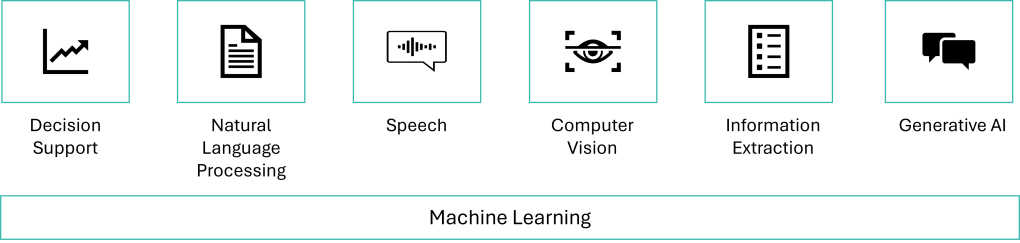
Fig 1: List of Azure AI Services
But there was a need for a central platform for managing the AI Projects and its lifecycle consisting of data prep, training, deployment, monitoring, security and governance. Hence came, Azure AI Studio and Azure AI Open studio.
Azure AI Studio served as a unified portal that brought together various AI-related services, including Azure OpenAI, Azure Machine Learning, and Azure AI Services. The concept of Projects and Hub was introduced.
Azure OpenAI Studio offered a simplified, purpose-built portal focused exclusively on the unique playgrounds and configurations for large language models like GPT-3, GPT-4, and DALL-E.
The combination of Azure AI Studio and Azure Open AI Studio worked well but there were still some gaps. Developers struggled to manage various AI tools and services across the full development lifecycle. There was also a need for a single platform to create, test and manage AI agents.
Comes in Azure AI Foundry. Foundry is the evolution and rebranding of Azure AI Studio and Azure OpenAI Studio, creating a single, unified Platform-as-a-Service (PaaS) offering for end-to-end AI operations. It moves beyond disparate services to provide an integrated environment for building complete AI-powered products and AI agents at scale.
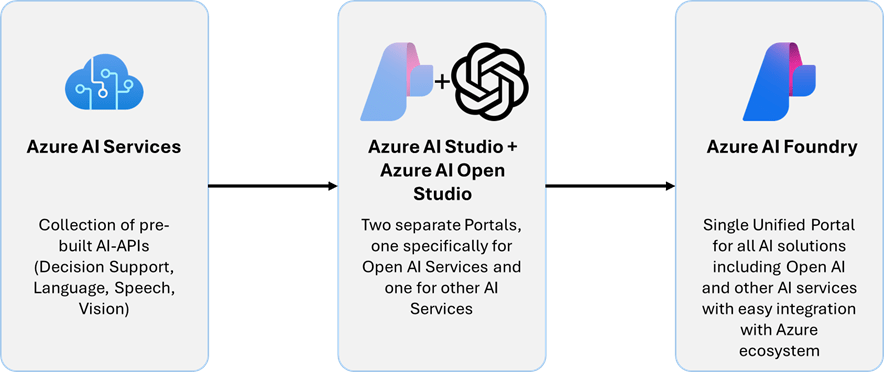
Fig 2: Evolution of Azure AI Foundry
What is Azure AI Foundry?
Azure AI Foundry is a platform-as-a-service (PaaS) offering. It is a unified Azure platform designed to help developers and enterprises build, manage, and deploy AI applications and agents. From a historical perspective, it combines the capabilities of Azure AI Studio and Azure Open AI Studio.
The two core components of Azure AI Foundry are:
- Azure AI Foundry Resource
- Azure AI Foundry Portal
What is Azure AI Foundry Resource?
The Azure AI Foundry resource is the foundational, back-end Azure object that provides the management, governance, and technical scope for all your AI development activities.
This includes agent service, models sold by Microsoft and its partners, evaluations, Foundry Tools and Azure OpenAI service capabilities.
Azure AI Foundry resource expands upon the Azure Open AI resource which is the back-end for accessing Open AI models.
It acts as a container for managing your AI projects, including access, security, and billing. You will notice that when you deploy a model in Azure AI Foundry, you are asked to select an Azure AI Foundry resource. This linkage allows you to use the models across projects. You can find more details of this in the article “AI Foundry Project vs Hub Project”.
What is Azure AI Foundry Portal?
The Azure AI Foundry portal is the graphical, web-based user interface that you use to interact with and manage Azure AI Foundry resource. The portal was earlier called Azure AI Foundry AI Studio.
Azure AI platform offerings are constantly changing and a clear understanding of how Azure AI Foundry has evolved, and its two core components are necessary to avoid any confusion with the changing landscape.
 dabidigital